

Executive Summary
- US consumer spending drives ~70 percent of GDP but spending is increasingly concentrated among high-income households.
- The top 10 percent now account for half of all spending, up from 36 percent over the past 30 years.
- Credit card and earnings data show lower earners cutting back while higher earners still spend freely.
- Early signs of caution are emerging even among the affluent, especially after the tariff announcements.
- A broader spending slowdown could pose real risks to the economy and financial markets.
- Investors should stay diversified and avoid overreliance on short-term consumer strength.
The US has been a consumer-driven economy since the 1920s, when mass production made cars, refrigerators, and radios affordable to the middle class and credit became widely available through installment plans. Today, consumption drives about 70 percent of US GDP, compared to roughly 40 percent in China.
That ties the fate of the broader economy closely to US consumers, which works fine as long as consumers keep spending.
But lately, a growing share of spending comes from the wealthiest households. And the gap between how high earners and low earners are behaving is only widening.
High-Income Households Now Dominate Spending
According to Moody’s Analytics, the top 10 percent of US households (those earning more than $250,000 annually) now account for half of all consumer spending, up from an average of 36 percent over the past three decades.1
But that kind of concentration isn’t necessarily healthy. Since high earners hold an outsized share of equities and real estate, a downturn in either market could ripple more severely through the economy.
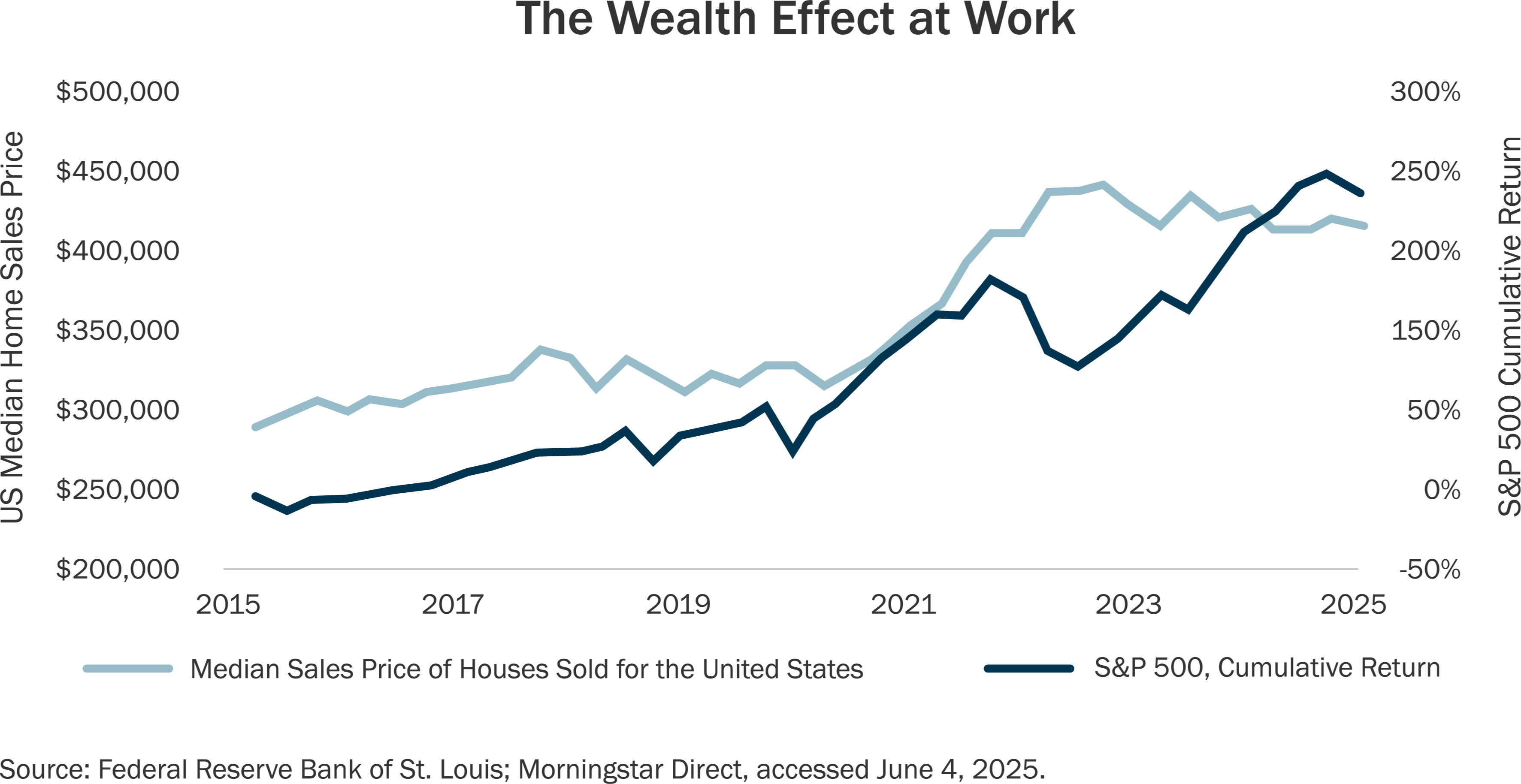
Over the past several years, rising home equity and an AI-fueled stock market rally have delivered massive wealth increases to high-income households, at least on paper. US home prices are up more than 40 percent from the start of the pandemic, and the S&P 500 has more than doubled over the past five years.
Consumer Pessimism is Increasing
The wealth effect has kept high-income spending afloat, even as broader sentiment has soured.
The University of Michigan’s monthly Surveys of Consumers show growing pessimism about personal finances and the labor market. Sentiment hit post-2008 lows after the widespread tariffs were announced in April, but in reality, attitudes have been trending downward for a while.

Spending Trends Confirm the Gap
Quarterly earnings reports from major credit card companies paint a clear divide between higher- and lower-income households:
- Synchrony Financial, which services retail-focused credit cards for chains like Lowe’s and T.J. Maxx, reported a 4 percent drop in spending for the first quarter of 2025, reflecting cutbacks by lower-income households.2
- Bread Financial and Citigroup’s retail card units also posted year-over-year spending drops of 5 percent (CNBC, April 28, 2025).2
- Conversely, American Express, whose clients tend to be higher-income, reported a 6 percent spending increase overall, including a 7 percent rise in restaurant spending and an 11 percent surge in premium airfare. The company also said that premium product demand has remained strong across its customer base.2
- JPMorgan Chase also reported strong credit card growth, driven by its affluent customer base.2, 3
The story is increasingly clear: higher earners are still traveling and dining out, while lower earners are cutting back to the basics.
Cracks at the Top May Be Forming
Even the wealthiest consumers may be planning for tougher roads ahead. A Harris Poll from March found that 12 percent of households earning over $100,000 couldn’t cover their bills, a worrying figure, even if less dire than the 33 percent among sub-$50,000 earners.4
And while inflation has hit low-income families hardest, it hasn’t left higher earners untouched, especially as tariffs threaten to raise prices further.
In May, a McKinsey ConsumerWise survey found that more than 60 percent of all consumers expected to change their spending habits due to tariffs, and even among wealthier households, there was a modest uptick in “trade-down” behaviors (e.g., switching to lower-priced brands), especially in categories like groceries and packaged goods.5
Meanwhile, 80 percent of consumer discretionary companies have issued weaker earnings guidance for Q2, expecting tariffs and general economic weakness to impact demand for nonessential goods.6
Increasing wealth from rising stock and real estate has helped high-income earners, maintain spending, but the housing market has softened in recent months, while the stock market remains volatile. Falling wealth could trigger more meaningful discretionary spending cuts among high earners.
Lower Earners Are Already Cutting Back
For households earning under $100,000, the pullback is already well underway.
Synchrony noted that discretionary spending among lower-income cardholders began falling more than a year ago. And the Philadelphia Fed reported that the share of credit card users making only minimum payments hit 11.1 percent in Q4 2024, the highest in over a decade.2
Walmart’s recent earnings call echoed the shift: “The consumer is pressured. We've seen for a couple of years now a shift…from general merchandise to… more necessities versus discretionary. So, people are spending more on food.”6
Key Takeaways
We’re seeing clear signs of a spending pullback, that’s already broadening and could accelerate further. That fits with our broader view that a US recession remains a distinct possibility in 2025.
Don’t take the headlines about strong consumer spending at face value. Beneath the surface, consumer strength is increasingly concentrated among high earners, and even the wealthy are beginning to cut back.
If stock markets or home values decline meaningfully, high earners could sharply scale back and trigger broader market weakness. Feedback loops could turn a correction into a crash, if wealth reduction from falling stock prices triggers spending cuts that result in stock prices falling even further.
That’s why we continue to emphasize diversification, even after the market rally of the past month or two. Rest assured, we’re watching both opportunities and risks and positioning your portfolios to weather - or benefit from- what may come next.
Sources:
- Moody’s Analytics via Business Insider, May 6, 2025.
- CNBC, "Wealthy consumers upped their spending last quarter," April 28, 2025.
- Business Insider, May 6, 2025.
- Harris Poll for Rakuten, March 2025 via Business Insider.
- McKinsey & Company, "An update on US consumer sentiment," May 30, 2025.
- BCA Research, “Closing Q1–25 Earnings Season: What Are Companies Telling Us,” May 26, 2025.