

Over the weekend, the Trump administration announced major new tariffs on key US trading partners, raising fresh concerns about trade tensions and their impact on markets. The executive orders put a 25 percent tariff on goods from Mexico and Canada (with a 10 percent tariff on Canadian energy products) and an additional 10 percent tariff on Chinese imports. The official reason? Curbing the flow of fentanyl and illegal immigration into the US.
However, in a last-minute development, President Trump agreed to delay the Canadian and Mexican tariffs for one month following new commitments from both countries to strengthen border enforcement and combat organized crime.
Meanwhile, China responded swiftly to the US tariffs, imposing its own levies on American coal, liquefied natural gas (LNG), crude oil, farm equipment, and autos, with additional trade restrictions targeting US tech companies. These rapid escalations renew concerns about an extended trade war and its broader economic impact.
Understanding the New Tariff Landscape
The key questions now are how long these tariffs will remain in place and whether they will lead to lasting changes in trade policy. If they are primarily a negotiating tool with specific objectives, further concessions may emerge. Mexico has already agreed to deploy 10,000 troops to its northern border, and Canada has taken steps, including naming a fentanyl czar and launching a joint task force with the US. While the 30-day pause on Canadian and Mexican tariffs provides a window for negotiation, the tariffs on Chinese goods remain firmly in place, with no immediate signs of de-escalation.
While the administration is framing these tariffs as a national security measure, there’s more to the story. President Trump has been a longtime proponent of tariffs—not just as a bargaining chip, but as a way to generate revenue and boost American manufacturing. During his 2024 campaign, he floated the idea of higher tariffs across the board, especially on Chinese imports, signaling a broader move toward protectionist trade policies.
The goal? To make foreign goods more expensive so companies are incentivized to manufacture in the US. There’s also speculation that tariff revenue could help offset federal deficits or fund other government priorities. In short, these tariffs may not just be a short-term negotiation tactic—they could be here to stay.
Markets are also paying close attention to how the outcomes of these trade negotiations with China, Mexico, and Canada might set the stage for future discussions with the EU. If the administration secures major concessions, it could embolden a more aggressive stance toward European trade relations, which have already been signaled as a potential next front in tariff policies.
Lessons from the First Trade War
A look back at the first round of tariff disputes under the Trump administration provides some important context for investors. From the start of the trade war in January 2018 through the end of 2024, the S&P 500 delivered a cumulative return of +133 percent, an annualized return of more than +23 percent. This suggests that markets can absorb trade disruptions better than expected.
Trade has also proven to be highly adaptable. During the previous trade war, US tariff rates on Chinese imports rose from 3 percent to 10 percent, leading China’s share of US goods imports to drop from over 21 percent to just above 15 percent. However, other countries, including Mexico, Vietnam, and the EU, stepped in to fill the gap. This adaptability underscores an important lesson: tariffs often redirect, rather than eliminate, trade flows.
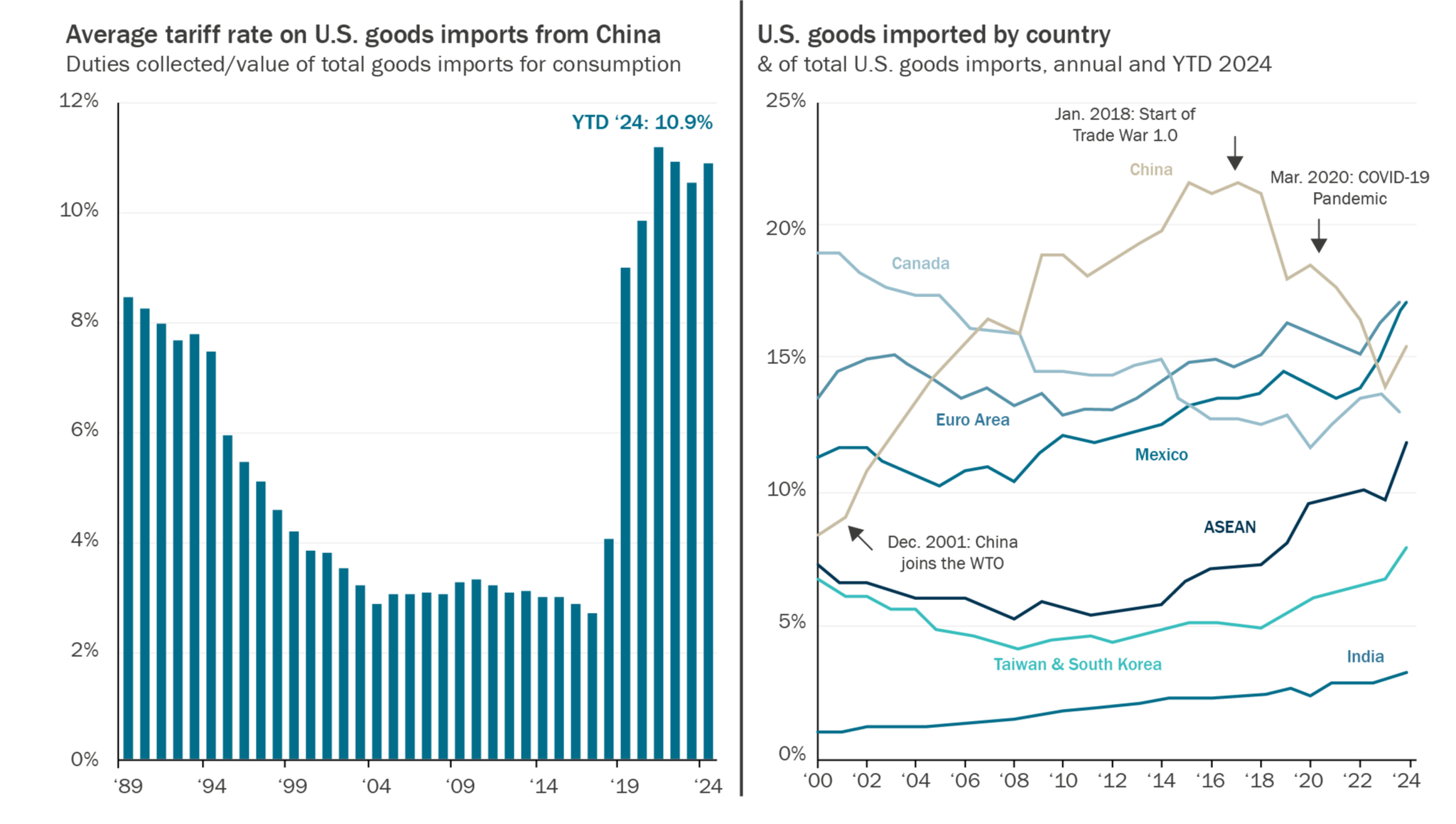
Source: JPMorgan Guide to the Markets, December 2024.
Where Things Stand Now
- Market Reaction: Stocks took a hit initially, dropping nearly 2 percent on Monday morning, but recovered some ground. The US dollar jumped, especially against the Canadian dollar and Mexican peso, while bond yields dipped as investors sought safe-haven assets. That said, it’s not a given that the dollar will keep rising—if the tariffs start to drag on US economic growth or push the Fed toward a policy shift, the dollar could lose steam.
- Global Pushback: China imposed swift retaliatory tariffs, targeting key US exports such as coal, LNG, crude oil, farm equipment, and autos. Additionally, China announced export controls on critical minerals and launched an anti-trust probe into Google. European leaders are also warning of potential retaliatory measures.
- Potential Changes: The tariffs on Mexico and Canada are temporarily paused, but the situation remains fluid. Trump has hinted at additional tariffs on the EU and further actions against China if negotiations stall.
- Economic Impact: If these tariffs stick, they could drive up costs across several industries, potentially leading to a temporary burst of inflation.
- Consumer Prices: Grocery prices may rise as Canada and Mexico supply a significant portion of US produce, meat, and grains. Essential consumer goods, including electronics and automobiles, could see delayed but eventual price increases as tariffs disrupt supply chains.
- Housing and Construction: Higher tariffs on Canadian softwood lumber and Mexican gypsum could raise construction costs, further exacerbating the affordability crisis in housing.
- Energy Costs: A 10 percent tariff on Canadian oil could lead to higher fuel prices, particularly in regions dependent on Canadian crude.
- Inflation Outlook: Analysts expect a temporary surge in inflation due to higher costs for imported goods, but not sustained long-term inflation. The Federal Reserve will closely monitor price trends to determine any necessary policy adjustments.
What This Means for Investors
Markets don’t like uncertainty, but they’ve weathered trade tensions before. Here’s what investors should keep in mind:
- Expect Some Volatility, but Don’t Panic
- Stocks will likely have some ups and downs as negotiations play out. The big question is whether these tariffs turn into something more permanent.
- The Federal Reserve will be watching inflation and economic growth closely before making any moves on interest rates.
- Consider Revenue Sources for US Companies
- Companies that do most of their business in the US may be less exposed to trade risks. Small- and mid-cap stocks, which tend to be more domestically focused, might hold up better.
- Watch Inflation and Interest Rates
- Higher tariffs mean higher costs for businesses and consumers, which could keep inflation elevated. That might make the Fed more cautious about cutting interest rates in the near term.
- Stay Diversified
- While trade uncertainty can rattle international markets, global diversification is still a key investment strategy. International stocks remain attractively priced compared to US stocks.
- The dollar’s strength has made international investments tricky, but that might not last. If the Fed pivots or trade disruptions slow US growth, the dollar could weaken, boosting returns on foreign investments.
Bottom Line
There’s no way to predict exactly how this trade situation will play out but making knee-jerk investment decisions based on headlines is rarely a good idea. A well-diversified portfolio and a long-term mindset remain the best ways to navigate market uncertainty.
We’re keeping an eye on these developments and will continue to provide updates as the situation evolves. If you have any questions about how these changes might impact investment portfolios, don’t hesitate to reach out to your advisor.
A diversified portfolio does not assure a profit or protect against loss in a declining market.
Additional risks are associated with international investing, such as currency fluctuations, political and economic stability, and differences in accounting standards.