

Key Takeaways
- DeepSeek, a Chinese AI company, is gaining attention for its energy-efficient, open-source AI model, challenging US tech dominance.
- Market concentration in US tech giants like NVIDIA and Broadcom raises concerns about long-term sustainability and diversification.
- Historical trends suggest that market leadership is transient, with AI infrastructure companies being the current front-runner.
- Investors should focus on diversification across industries, company sizes, and geographic regions to mitigate risks and capitalize on new opportunities.
In recent days, the global financial markets have been abuzz following news about China’s emerging AI company, DeepSeek, and its potential to disrupt the landscape of artificial intelligence (AI) and the broader equity market. This development has sparked significant market reactions, including declines in the stock prices of US AI companies. Understanding these shifts is critical to navigating potential risks and opportunities in the market.
US Equity Market Concentration
The global equity market has become heavily concentrated in US companies, particularly the so-called "Magnificent 7" (Apple, Microsoft, Amazon, NVIDIA, Google parent Alphabet, Meta, and Tesla). Many US companies have increased in value on the back of AI-driven growth, with the US now accounting for a staggering 67 percent of global equity market capitalization[1]—despite representing less than 20 percent of global GDP.[2]
This concentration stems from investor confidence in US dominance in AI, underpinned by massive investments in server farms, proprietary AI models, and cutting-edge chips. However, DeepSeek’s innovative approach—delivering open-source AI software that appears to be significantly more efficient and cost-effective—could challenge the foundation of this dominance.
A Lesson from History: Market Leadership is Transient
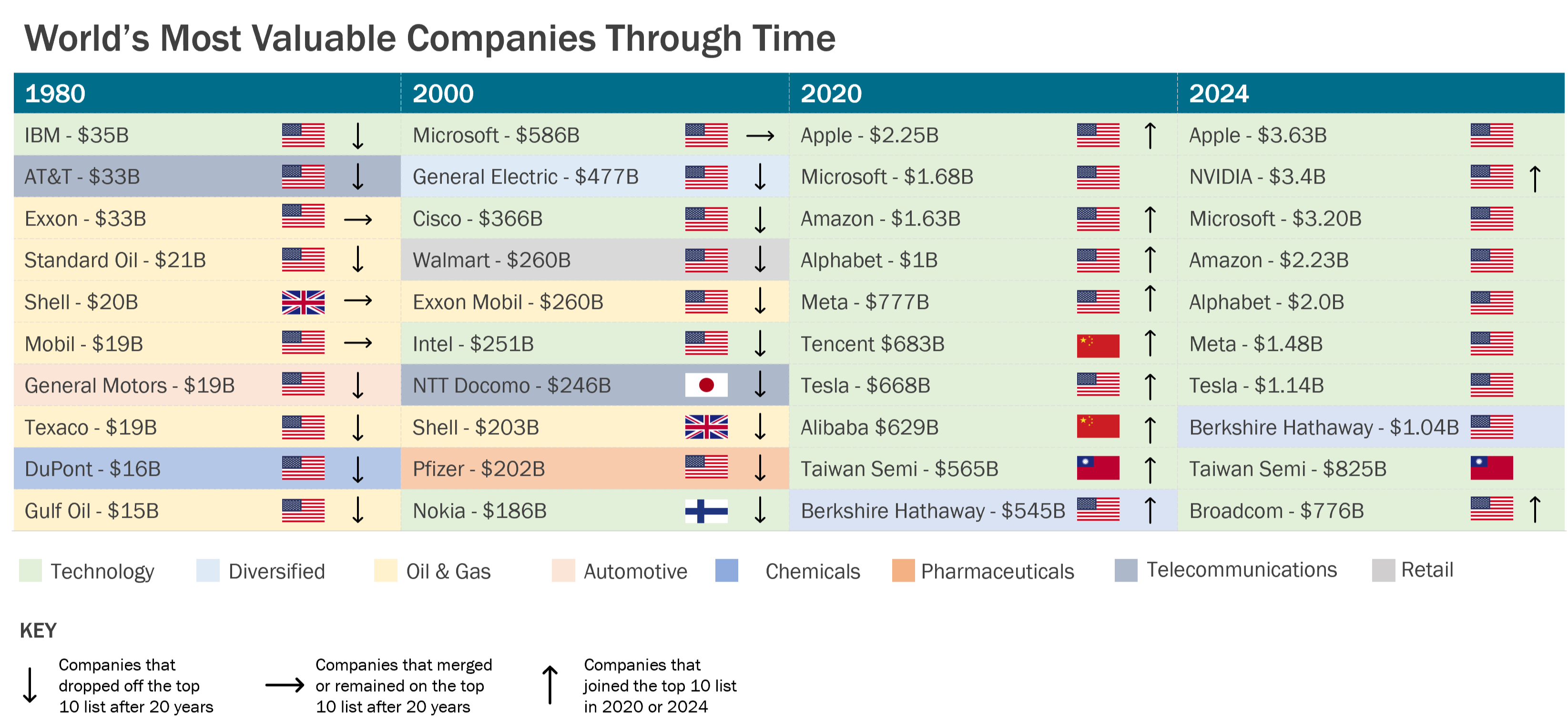
One key takeaway from our firm’s research on market trends is that the world’s most valuable companies rarely maintain their dominance over the long term. For example, during the 1980s, oil and gas companies including Exxon, Standard Oil, Shell, and Mobil made up the majority of the world’s ten most valuable companies.[3] These firms dominated global markets amid soaring energy demand, but had mostly fallen from the top 10 by 2000—and by 2020, none remained.
Similarly, the transition from 2000 to 2020 highlighted the rapid shifts in market leadership. In 2000, companies like Intel and Cisco, which benefited from the internet build-out, topped the rankings. However, by 2020, these firms were displaced by technology giants focused on consumer applications, cloud computing, and digital ecosystems. Microsoft was the sole company to remain in the top 10 over those 20 years, underscoring the rarity of sustained leadership.[4]
Today, the AI revolution has made chipmakers like NVIDIA and Broadcom among the most valuable companies. However, history suggests that as industries mature and competition intensifies, market leadership tends to shift. Companies leveraging AI to create innovative applications may eventually outpace those focused on building AI infrastructure. DeepSeek’s emergence could be the first sign of this transition.
A New Wave of AI
DeepSeek’s software reportedly consumes significantly less energy and memory than US competitors, offering a powerful yet efficient alternative to the resource-intensive strategies pursued by major US tech firms. This efficiency is driven by its "Mixture-of-Experts" (MoE) architecture, which activates only a fraction of the model’s parameters at a time, reducing costs while enabling iterative learning. DeepSeek also stands out for its open-source approach—R1 is available under the MIT License, allowing developers to freely modify, integrate, and deploy it, fostering innovation and broader applications. Remarkably, DeepSeek built R1 in just two months with under $6 million in funding, yet its performance reportedly rivals ChatGPT.
This development raises questions about the long-term sustainability of business models built on expensive, closed-end AI systems. If DeepSeek’s approach gains traction, it may mark a shift toward more accessible AI, where innovation is no longer monopolized by a handful of US tech giants.
While it remains unclear whether this moment marks the beginning of a broader revaluation of US tech stocks, the expansion of AI access could lead to a wave of new opportunities, both within the US and abroad, spurring innovation and competition across industries.
What Does This Mean for Investors?
For investors, DeepSeek’s rise serves as a reminder of the dynamic nature of markets and the importance of diversification. While US tech giants have been a cornerstone of portfolios in recent years, the concentration of equity market value in a few companies poses risks, particularly if market leadership begins to shift. To mitigate these risks, investors should diversify across company size, industry, and geography, to capture growth opportunities while reducing exposure to any single sector or market. At SageView, maintaining broad diversification within our client portfolios is always a priority—especially in times of extreme market imbalances, such as the current overvaluation of many US technology companies.
At the same time, the potential expansion of AI presents exciting opportunities. A more accessible AI ecosystem could fuel innovation across sectors, benefiting smaller players and enabling new applications that drive economic growth.
Looking Ahead
Whether DeepSeek’s emergence represents a "blip" or a transformative moment in the AI landscape, one thing is certain: the evolution of technology and markets will continue to bring new challenges and opportunities. By 2040, we may see a radically different list of the world’s most valuable companies, reflecting shifts in technology, competition, and global economic power.
For now, investors should remain vigilant, mindful of both the risks posed by market concentration and the opportunities offered by disruptive innovation. The rise of DeepSeek—and the global competition it signals—underscores the importance of flexibility and forward-looking strategies within your portfolio.
[1] MSCI. US percentage of MSCI All Country World Index as of 12/31/2024
[2] International Monetary Fund. US GDP based on PPP, percentage of world
[3] InvestmentNews.com
[4] Wikipedia.org