

Key Takeaways:
- Nvidia is the global market leader this year. Although it brings exciting opportunities for growth, we feel that caution is warranted given its high valuations.
- Nvidia's rapid growth is reminiscent of Cisco Systems in the late 1990s. Cisco experienced a similar rise to prominence before falling more than 80 percent.
- The outperformance of the broader large-cap growth sector parallels the technology bubble of the early 2000s. While the internet's development brought new opportunities, investors would have fared better with a diversified portfolio compared to being concentrated in the large-cap growth sector.
Nvidia’s market dominance
As financial advisors, our primary goal is to identify opportunities that balance growth potential with prudent risk management. In the current tech-driven landscape, investors have been particularly focused on large-cap growth stocks, especially those tied to AI and data center expansion. Over the past two years, the technology sector has offered fantastic investment opportunities. While we continue to see promising developments from AI across various industries, we believe caution is necessary and diversification remains as crucial as ever.
A significant beneficiary of the AI revolution has been Nvidia, whose stock has surged almost 150 percent this year[1]. Nvidia has transitioned from a graphics chip manufacturer to a global leader in GPUs (Graphics Processing Units), AI, and data center solutions. Its innovations drive applications from gaming to autonomous vehicles and deep learning, placing Nvidia at the forefront of transformative technologies. Its market cap skyrocketed from $1 billion to $3 billion in less than a year, making it the world's second-largest company behind Microsoft.
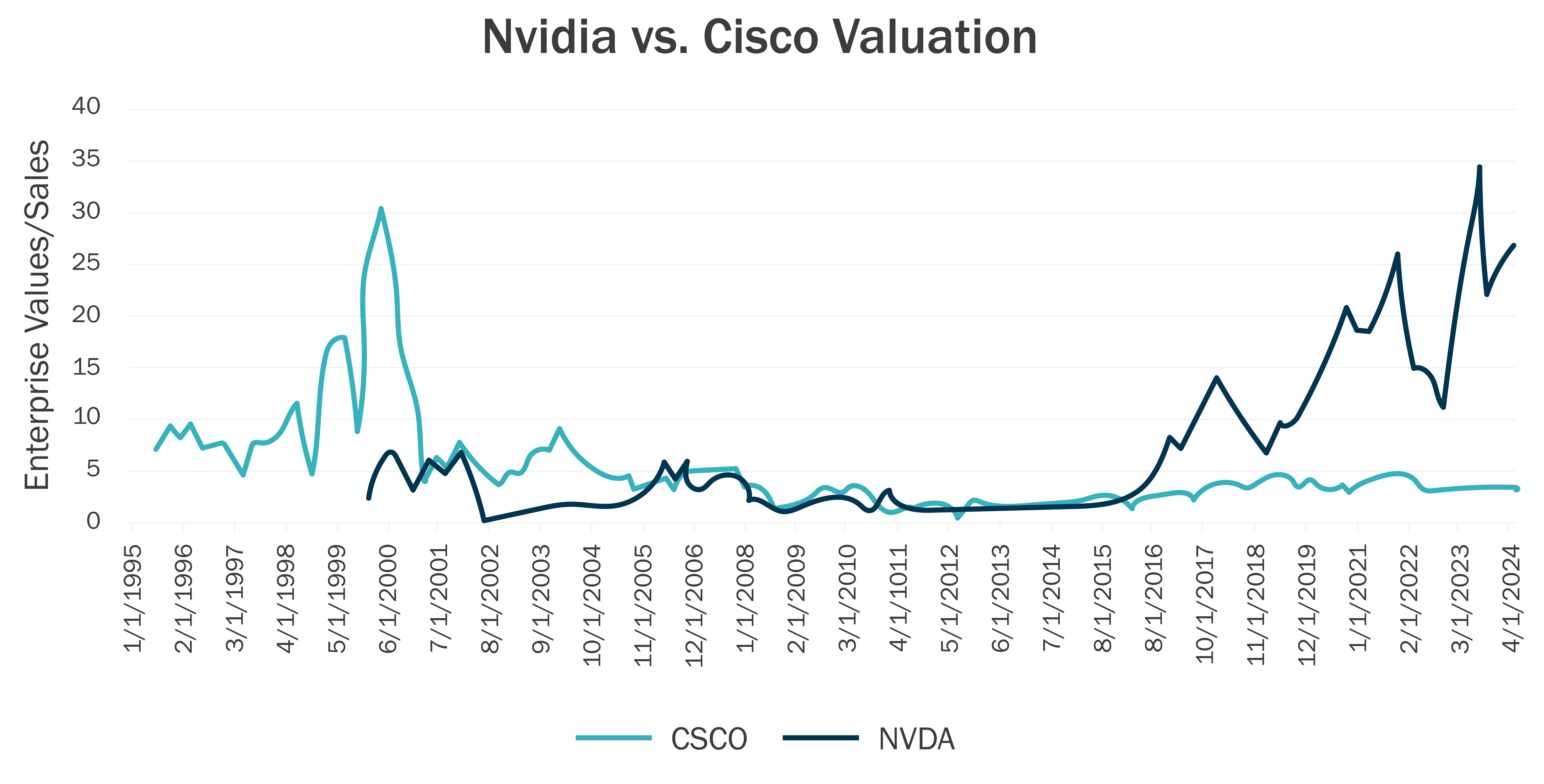
While Nvidia’s sales have grown exponentially in recent years, its market cap has increased even more rapidly. The company's enterprise value to sales ratio (EV/Sales), a popular valuation metric, has risen to 26.38, compared to its long-term average of 7.88. This is over four times higher than the technology sector as a whole, which has an EV/Sales ratio of 5.41, and more than twice that of Microsoft, which has an EV/Sales ratio of 11.79[2]. This indicates that Nvidia is relatively expensive at its current price considering its sales volume.
Nvidia’s similarities to Cisco
Nvidia’s historic growth reminds us of Cisco Systems in the 1990s. Cisco was a dominant force in networking hardware, crucial for the rapid expansion of the internet. Its routers and switches became synonymous with global connectivity, driving its meteoric rise and market dominance. Investors flocked to Cisco stock, anticipating continued growth due to the internet's expansion. However, despite the internet's enduring presence, Cisco's stock plummeted after a 200 percent surge from 1998 to 2000[3]. More than 20 years later, Cisco's stock has yet to reach its early 2000 peak. Similar to Nvidia, Cisco’s EV/Sales ratio peaked at 30.5 during the dot-com bubble in 2000, before falling to 4.5 a year later.[4]
Source: FactSet.
A Case for Diversification
Beyond Nvidia, the large-cap growth sector of the US market has significantly outpaced the broader stock market recently. Investors have gravitated towards growth companies over the past two years, partly due to low interest rates benefiting companies reliant on debt for investment, and partly due to excitement around AI. While this excitement is justified, there are parallels to the early 2000s technology bubble centered on the internet's development and expansion.
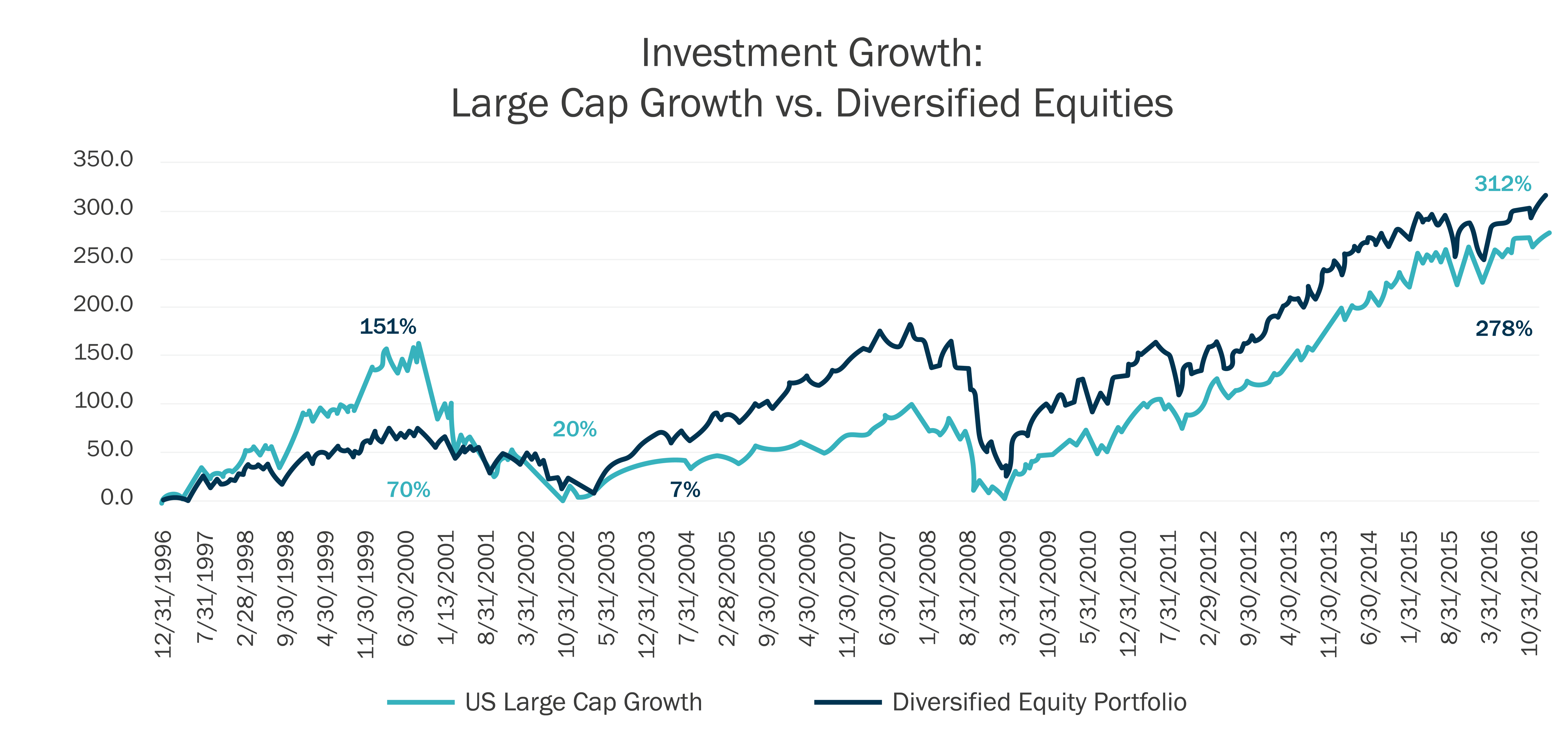
Consider two investors during the late 1990s tech boom: one concentrated in large-cap growth stocks, and the other holding a diversified portfolio of large, mid, and small caps, along with international stocks and real estate. The concentrated investor would have earned a cumulative return of 151 percent through the tech boom (1997 to mid-2000)[5], while the diversified investor earned around 70 percent[6]. It might seem that diversification was detrimental during this period, and concentration in high-growth areas paid off.
However, if we extend the timeframe by two more years as the tech bubble burst, the diversified investor came out ahead with a return of 20 percent compared to just 7 percent for large-cap growth. Looking longer-term, over a 20-year period, the diversified investor achieved a total return of 312 percent through 2016, while the large-cap growth investor earned 278 percent. While sectors like value stocks and international equities underperformed during the tech boom, maintaining investments in these areas proved beneficial in the long run. Not only did the diversified portfolio yield a higher cumulative return, but it also provided a smoother, less volatile investment experience over the entire period.
Source:Morningstar Direct
This demonstrates the importance of diversification, even when one market sector appears to be dominating. There will be booms and busts in different market areas over time, and selecting the right stocks and sectors at the right time is extremely challenging, even for professionals. Deciding when to sell an investment is even tougher. Investors that attempt to time the market often hold onto a losing investment for far too long, potentially jeopardizing their retirement or other financial goals. Research shows that over the long term, combining different asset categories can lower volatility and typically achieve similar, if not higher, returns compared to focusing on a single outperforming category.
As we navigate these dynamic times, please rest assured that we are diligently monitoring the markets and our client portfolios. Our commitment is to ensure your investments are well-positioned for long-term stability and growth, balancing exciting opportunities with prudent risk management. Should you have any questions about the markets or how your portfolio is positioned, please don’t hesitate to reach out to your Financial Advisor.
[1] FactSet. Nvidia total return through 7/10/2024
[2] FactSet. Information Technology Spliced Index used as a proxy for the technology sector
[3] FactSet. Cisco total return from 1/1/1998 to 12/31/2000
[4] FactSet
[5] Morningstar Direct. Cumulative return of the Russell 1000 Growth Index
[6] Morningstar Direct. Diversified equity portfolio consists of 40% S&P 500, 10% Russell Mid Cap, 8% Russell 2000, 32% MSCI EAFE, and 10% FTSR Nareit All Equity REITs