

Cash Balance Plans offer path around income limits in new tax law
Business owners and high-income professionals are discovering an unexpected tax shelter buried in President Trump's latest legislation: Cash Balance Plans can slash tax bills by tens of thousands of dollars while circumventing new income restrictions on some of the eligible deductions.
The One Big Beautiful Bill Act (OBBBA), signed into law this past July 2025, quadrupled the state/local income and property tax deduction cap (SALT deduction) from $10,000 to $40,000, a windfall for taxpayers in high-tax states like California and New York. But there's a catch: the enhanced deduction phases out 30 percent for every Adjusted Gross Income (AGI) dollar earned over $500,000 until it vanishes at $600,000.
Enter the Cash Balance Plan, a retirement vehicle that allows business owners and high wage earners to contribute far more than traditional 401(k) Profit Sharing limits while dramatically reducing their taxable income. Unlike defined contribution plans, Cash Balance Plans can accommodate annual contributions potentially exceeding $350,000, depending on age and income level, above and beyond the 401(k) Profit Sharing legal contribution limits. Additionally, while both 401(k) and Cash Balance contributions defer federal and state income taxes, Cash Balance also avoids additional payroll taxes like Medicare taxes and California SDI taxes as example.
With tax deductions increasingly limited for high wage earners, Cash Balance Plans provide one of the few remaining ways to not only substantially reduce a taxpayer’s AGI, but by doing so it may preserve access to new deductions and credits offered by OBBBA, as well as limit exposure to ancillary “stealth” taxes such as a higher long-term capital gains tax, the Net Investment Income Tax (3.8 percent if AGI is greater than $200,000 (S)/ $250,000 (MFJ) and the Medicare surtax (IRMAA), among others. And let’s not forget that starting January 1, 2026, high-wage earners take another hit with the loss of the Catch-Up contribution being pre-tax. For those earning more than $150,000 in 2025, all 2026 Catch-Up contributions ($8,000 -$11,250 depending on your age) are required to be Roth after-tax contributions.
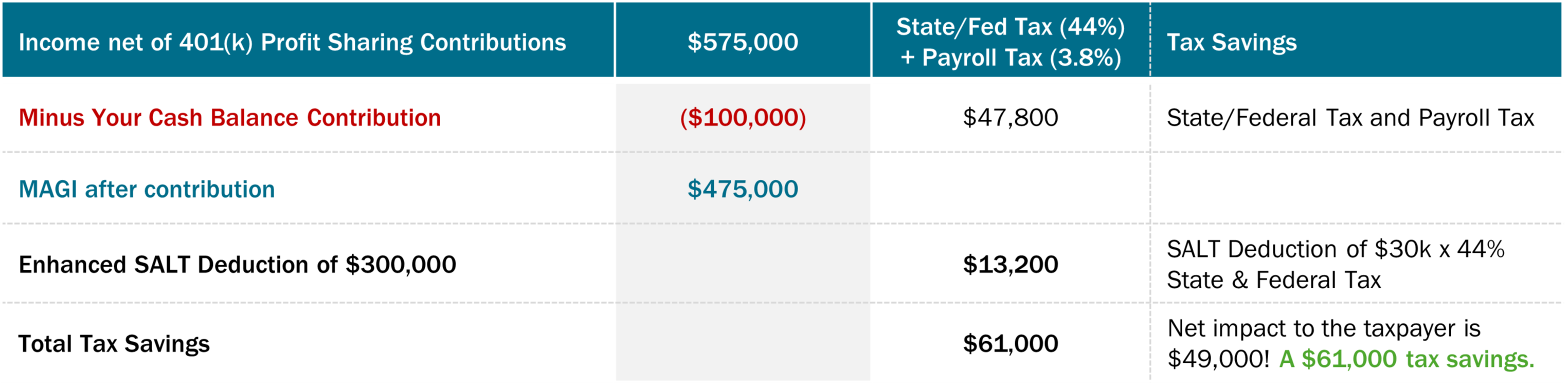
As to how it can help, let’s go back to the enhanced SALT deduction as an example. The math is compelling for those just above the income phase-out range of $500,000 -$600,000 in MAGI. Consider a professional (or professional couple) having a Modified Adjusted Gross Income (MAGI) of $575,000 in 2025, after maximizing 401(k) and Profit-Sharing contributions. By also re-directing $100,000 of their income into a Cash Balance Plan that they are eligible for, MAGI drops below the $500,000 limit and unlocks the full $40,000 SALT deduction. With that reduction in income, the tax benefits cascade. That $100,000 contribution generates immediate deductions: 35 percent federal income tax relief, plus state tax savings (9.3 percent in California), Medicare payroll tax avoidance of 1.45 percent, and elimination of the 0.9 percent Medicare surtax for high earners. In California, taxpayers also avoid the 1.20 percent California State Disability Tax, which was previously capped at $145,000 of income before having the cap removed in 2024. Combined, these savings can reach up to 47.8 percent of the contribution amount, or $47,800 or more in total income and payroll tax savings. (results will differ by state due to the different state and payroll taxes).
Simultaneously, qualifying for the enhanced SALT deduction provides an additional $13,000 in tax relief at the 35 percent federal and 9.3 percent marginal California State income tax rates on top of the tax breaks described above.
The result? $61,000 in total tax savings on a $100,000 contribution—effectively reducing the high-wage earner’s real cost to just $39,000, a 61 percent tax savings on each dollar contributed!
Any CPA, worth their salt, would bless that strategy (pun intended).
However, the window is narrowing. The enhanced SALT deduction sunsets after 2029, providing a multi-year opportunity to accelerate retirement savings while capturing otherwise elusive tax benefits. Strategic income management through Cash Balance contributions may also unlock additional deductions, including the $6,000-$12,000 senior deduction for those who can reduce their income below $75,000 for single filers or $150,000 for married couples filing jointly.
For qualifying professionals, the timing alignment of enhanced SALT deductions and Cash Balance contribution limits creates a narrow but potentially lucrative planning opportunity—one that may not persist beyond the current legislative window.
If you do NOT have a Cash Balance Plan, and you are looking to take your retirement and tax savings to the next level, let us provide you with a complementary study to show you whether or not a Cash Balance Plan makes sense for your firm or company.
If you are a sole proprietor or small business owner and don’t have a Cash Balance Plan, but have a significant tax liability, let us show you how we can help you reduce that liability and accelerate your savings at the same time.
If you have a Cash Balance Plan and have a need to educate or review the benefits of the plan with them in light of OBBBA, SageView can provide that service for you. We would welcome the opportunity to discuss how we can partner with you to help your participants maximize their tax savings.
Steven S. Sansone, J.D., AIF®, CPFA®is Managing Director of the SageView Advisory Group, LLC Valencia Office. With four decades of experience servicing retirement plans , he is recognized as an authority in Cash Balance Plan design and investment management, specializing in solutions for professional service groups and business owners seeking tax optimization and accelerated savings. Steve’s expertise has earned significant industry recognition. The SageView Valencia office was named a NAPA Top DC Advisor Firm for 2025, and Steve was personally recognized as one of Plan Adviser’s Top Retirement Plan Advisers 2025 (Top Cash Balance). Steve is co-author of Beyond the 401(k): How Financial Advisors Can Grow Their Businesses with Cash Balance Plans, and earned his J.D. from SUNY @ Buffalo School of Law. He can be reached at (818) 262-3458 or ssansone@sageviewadvisory.com.